
Key Takeaways
A few weeks ago a patient came into our clinic with a frozen shoulder.He listened as our physiotherapist explained how frozen shoulders actually recov...
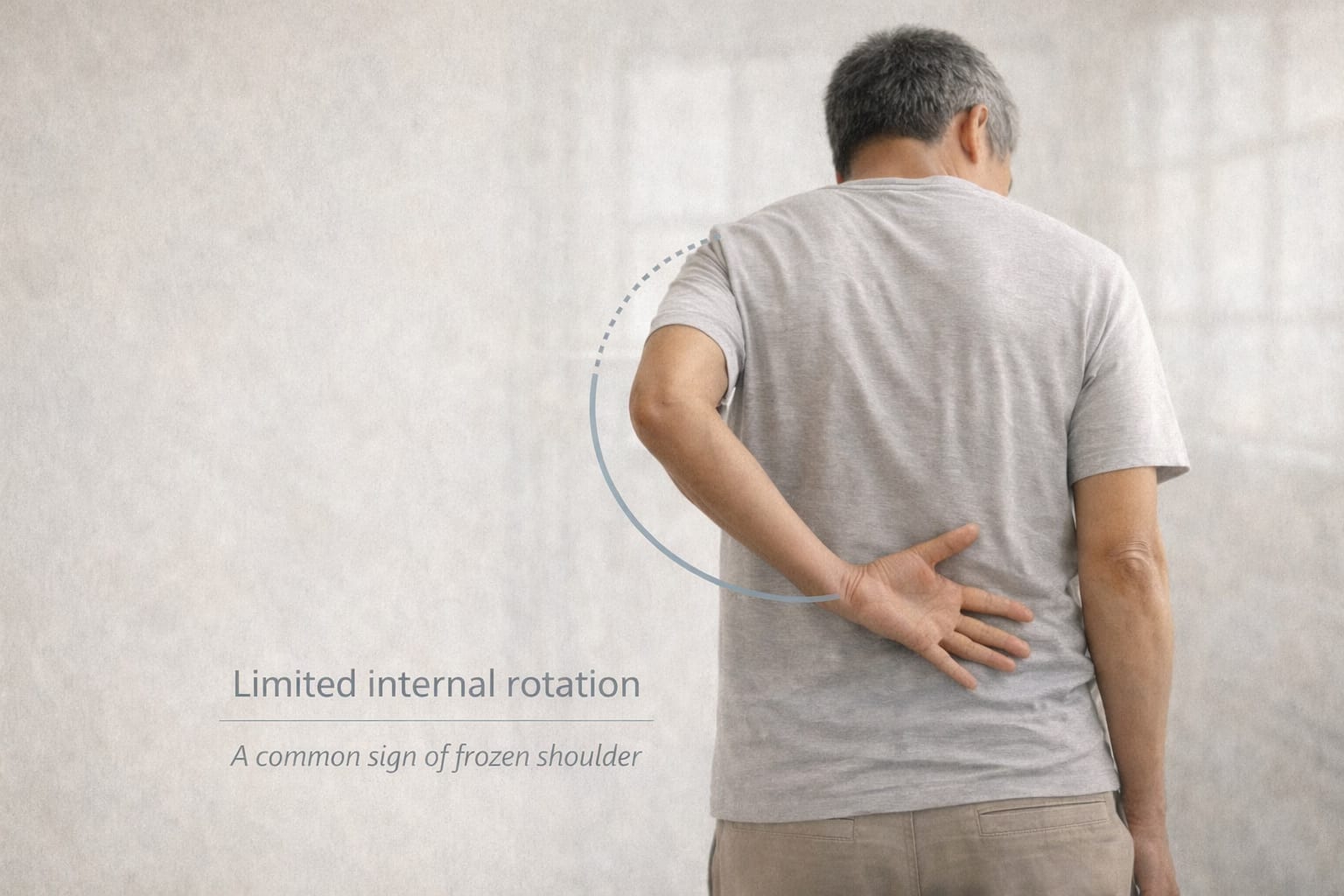
A few weeks ago a patient came into our clinic with a frozen shoulder.
He listened as our physiotherapist explained how frozen shoulders actually recover — slowly, over phases, with inflammation settling first, movement returning gradually, and strength rebuilt over time. Even though our combination treatment with anti-inflammatory herbal patches would speed up healing, there was no promise of a dramatic breakthrough. No single moment where everything would suddenly “unlock.”
He declined treatment.
Later that day, he wrote to say he felt disappointed. He had expected an adjustment — something decisive, something forceful. His intuition, fed by videos on social media told him: a shoulder that doesn’t move must be “locked,” and a locked thing should be forced open. Anything quieter felt inefficient, even dishonest.
We now live in a world where the most convincing pain treatments are often the ones promoted by social media algorithms. These tend to be treatments that generate visceral emotion - the “ick” feeling of pimple popping, or the vicarious relief of a loud crack.
The Intuition We’ve Trusted for Centuries
For most of human history, medicine was guided by resemblance.
If a man wanted strength, he consumed the blood or organs of a strong animal.
If a plant resembled a heart, it was believed to heal the heart.
If a leaf looked like a liver, it must be good for liver disease.
If illness caused swelling or agitation, bloodletting and leeches were used to “release” the excess.
Disease itself was blamed on miasma — invisible clouds of bad air rising from decay. The logic was intuitive: foul smells made people sick, therefore the smell must be the cause.
These ideas weren’t foolish. They were human. In the absence of microscopes, people trusted what they could see, smell, and feel. Treatment mirrored appearance. Force matched severity. Symbol stood in for mechanism.
What’s uncomfortable to admit is that this instinct never disappeared.
It modernised.
When Medicine Advanced by Defying Intuition
Modern medicine only progressed when it broke decisively with resemblance-based thinking.
Disease did not come from bad air; it came from microorganisms no one could see.
Bleeding patients did not restore balance; it weakened them.
Clean water mattered more than pleasant smells.
Handwashing saved more lives than heroic interventions.
These ideas were fiercely resisted at the time precisely because they felt wrong. They contradicted intuition.
Pain medicine, however, still struggles to make this leap.
So What Is That Loud Crack You Hear?
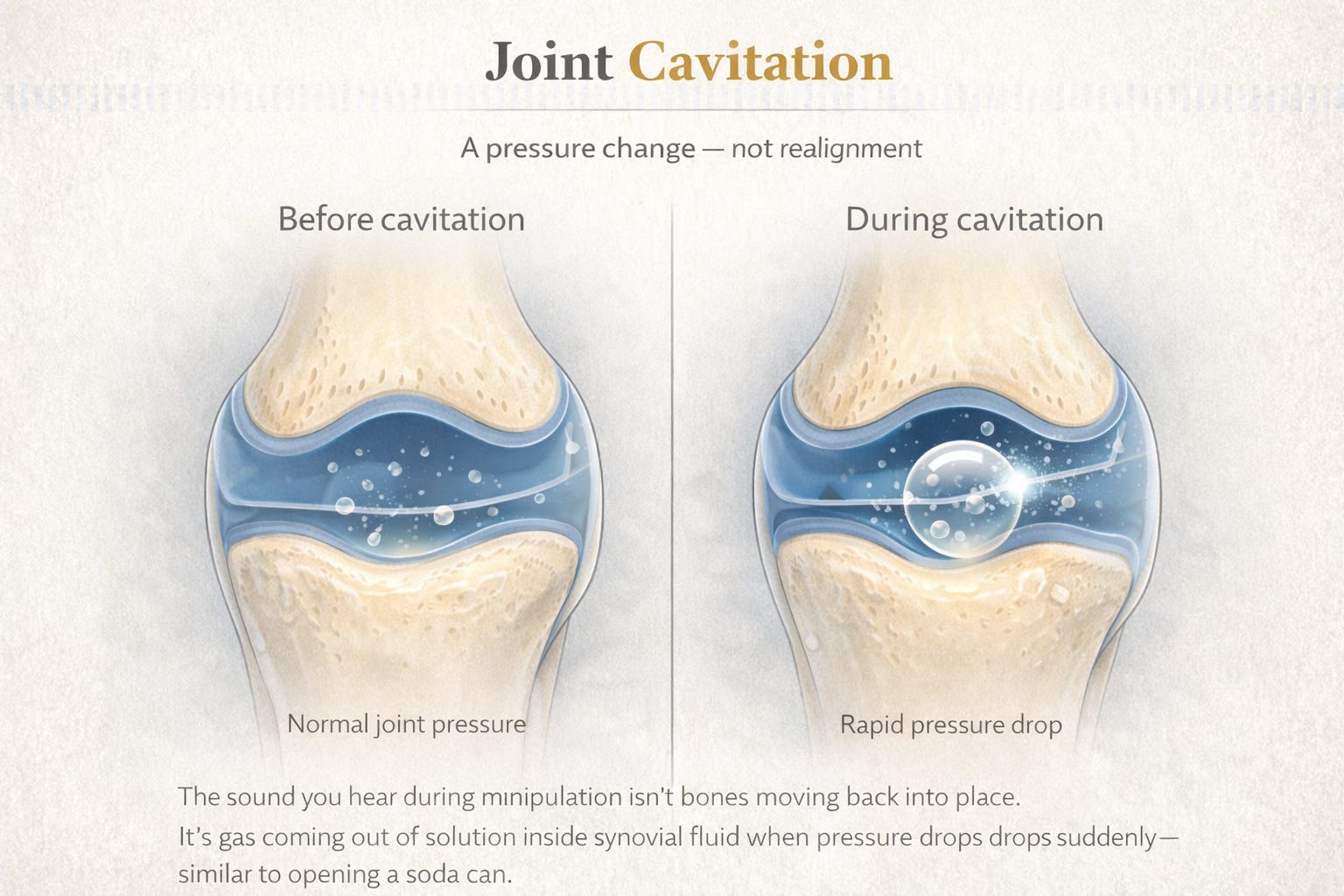
The loud crack heard during manipulation feels like proof that something structural just shifted back into place.
But it isn’t.
The sound comes from joint cavitation — a rapid pressure change inside the joint. Synovial fluid contains dissolved gases, primarily nitrogen. When a joint is suddenly distracted, pressure drops quickly, allowing a gas cavity to form. That event produces the audible pop.
Mechanically, it’s closer to opening a soda can than fixing a mechanical fault — a pressure change that creates a gas bubble, not a structural realignment.
In a 2015 study published in PLOS One, real-time MRI imaging showed that the sound coincides with gas cavity formation rather than joint repositioning. There is ongoing scientific discussion about the precise acoustics, but the core conclusion remains: the crack is not bones going back into place.
The sound is real.
The interpretation is the error.
Why It Still Feels So Convincing
Manipulation can feel genuinely relieving — and this is where confusion takes hold.
A sudden movement paired with a loud sound floods the nervous system with sensory input. The brain registers significance. Pain signals can temporarily quiet down. Muscles that have been guarding — tightening reflexively to protect an area — may briefly release. That release can feel like something ‘fixed itself’, even when nothing structural has changed.
Movement feels easier. Relief feels immediate.
Expectation amplifies this effect. When someone already believes the crack is the cure, the brain’s own pain-modulating systems reinforce that belief. This is not placebo in the dismissive sense. It is normal neurobiology.
But sensation is not resolution.
A nervous system response can change how pain feels without changing what’s driving it. And when we mistake the two, intuition once again replaces understanding.
Where Intuition Does Real Harm
Frozen shoulder is where this intuition fails most clearly.
A frozen shoulder isn’t “locked” like a jammed drawer. It is an inflammatory condition in which the joint capsule thickens, stiffens, and becomes highly irritable over time.
Force does not unlock it. Early, aggressive manipulation often worsens inflammation, increases muscle guarding, and sensitises the nervous system further.
There is a place for manipulation under anaesthesia in frozen shoulder — but only in selected cases, typically after prolonged conservative treatment fails, and under controlled medical conditions. This distinction matters. Force is not inherently wrong; misapplied force is.
What frustrates me is not that manipulation exists as a tool, but that resemblance is mistaken for understanding — that treatments are chosen because they look right, not because they match what's actually happening in the body.
When the Algorithm Becomes the Arbiter of Truth
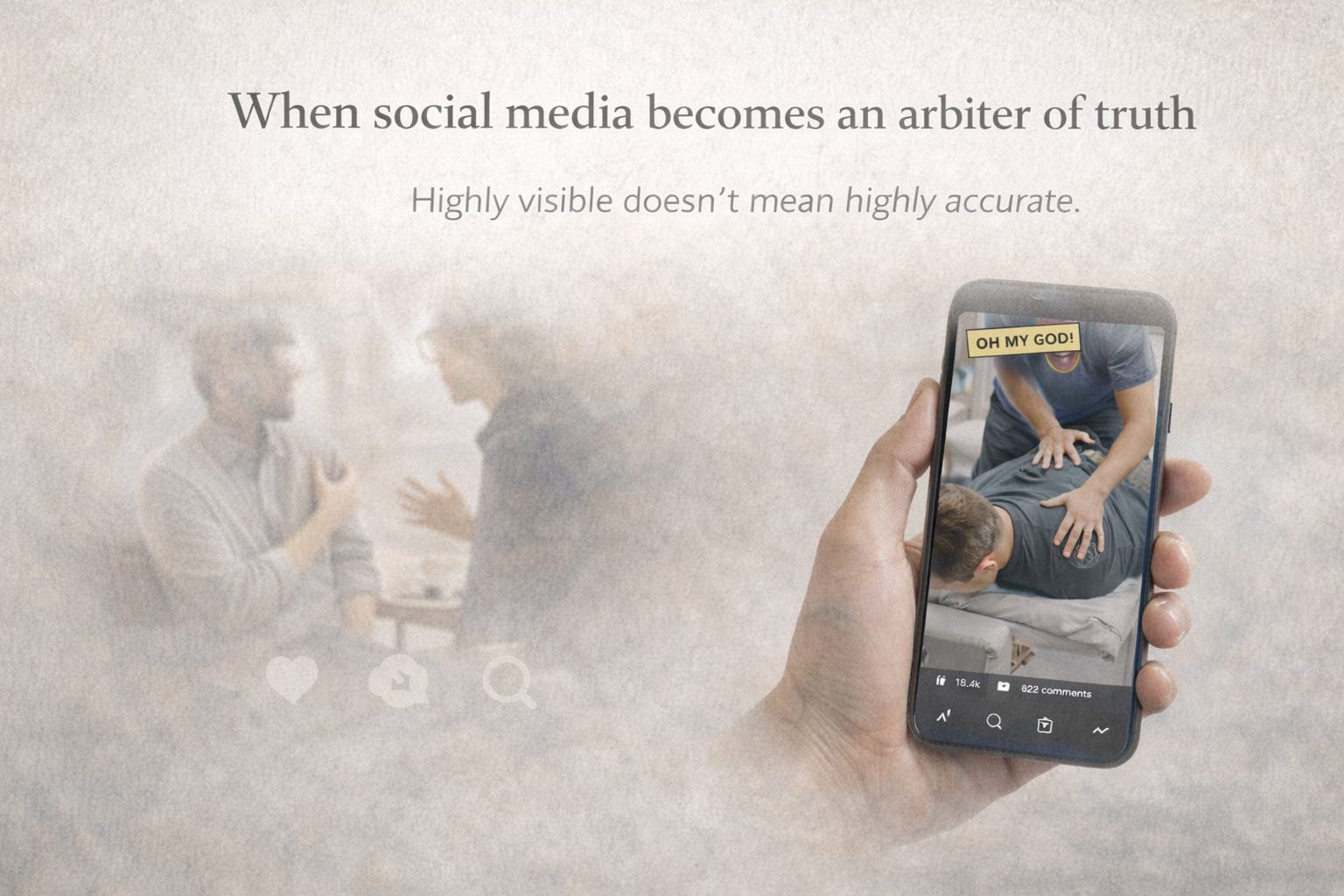
Social media did not invent this intuition. It rewards it.
Algorithms don’t promote outcomes. They promote engagement. And the treatments that perform best on screen are the ones that generate immediate, unmistakable signals: loud sounds, visible force, dramatic reactions.
This is why cracking videos dominate pain-related content today. Not necessarily because cracking works best — but because it works best for the algorithm.
Slow recovery doesn’t trend. Context doesn’t trend. Four weeks of steady improvement doesn’t stop the scroll.
In this environment, spectacle becomes mistaken for effectiveness, and intuition is reinforced thousands of times a day.
Moving Beyond Intuition
For most of history, we treated illness by resemblance. We trusted what looked right, sounded right, and felt right.
Modern medicine advanced when it learned — repeatedly — that intuition is often the least reliable guide to causation.
Pain care has been slower to accept this lesson.
The crack feels convincing because it fits an ancient instinct.
The force feels appropriate because the problem looks rigid.
The moment feels real because it is loud and immediate.
But pain does not respond to symbolism.
It responds to time, biology, and the slow rebuilding of trust between body and brain. And that, more than any algorithm or viral video, is what still makes recovery hard to recognise.