
Key Takeaways
Last week, a patient came into our clinic with what is commonly called a frozen shoulder.Our physiotherapist explained how this condition usually beha...
Last week, a patient came into our clinic with what is commonly called a frozen shoulder.
Our physiotherapist explained how this condition usually behaves — that true frozen shoulder (medically called adhesive capsulitis) involves inflammation and fibrosis (scar-like tissue formation) of the shoulder joint capsule, leading to progressive stiffness over time. He explained that recovery tends to be gradual, and that effective care usually focuses on calming inflammation, restoring movement progressively, and rebuilding function in stages.
The patient declined treatment.
Later that day, he wrote to us saying he felt disappointed. He had expected a shoulder adjustment that would “fix” the problem. The implication was clear: he already knew what would work — and that we were either withholding it or trying to deceive him.
That message stayed with me.
Not because the patient was unreasonable, but because his expectation didn’t come from nowhere. It came from what he had seen repeatedly online: dramatic videos showing long-standing pain problems being “fixed” instantly through forceful adjustments.
This article is about why those videos feel convincing — when hands-on techniques can genuinely help, when they’re unlikely to help, and how social media can quietly distort what we expect pain treatment to look like.
Why Viral Pain Videos Are So Convincing
Scroll long enough and you’ll see the pattern:
A loud crack.
A big reaction.
A clear “before and after.”
These clips are persuasive because they show immediate change, and immediate change feels like proof.
From a biological perspective, there are several reasons pain or movement can change quickly:
1. Strong sensory input can temporarily reduce pain
Hands-on techniques can influence pain through the nervous system. Modern pain science shows that pain does not reliably correlate with tissue damage — it is also shaped by how the brain and spinal cord interpret threat and safety. This is a core principle of contemporary pain neuroscience (see resources from Pain in Motion and the Explain Pain framework).
2. Muscle guarding can drop rapidly
Muscle guarding is a protective tightening of muscles around a sensitive or threatened area — the body’s way of bracing when it anticipates danger. When guarding eases, movement can suddenly look much better.
3. Expectation and context matter
Confidence, ritual, authority, and dramatic sensory cues can all reduce perceived threat. This aligns with well-established research on contextual and placebo effects in pain treatment.
All of this can produce real, short-term changes.
But there’s an important limitation:
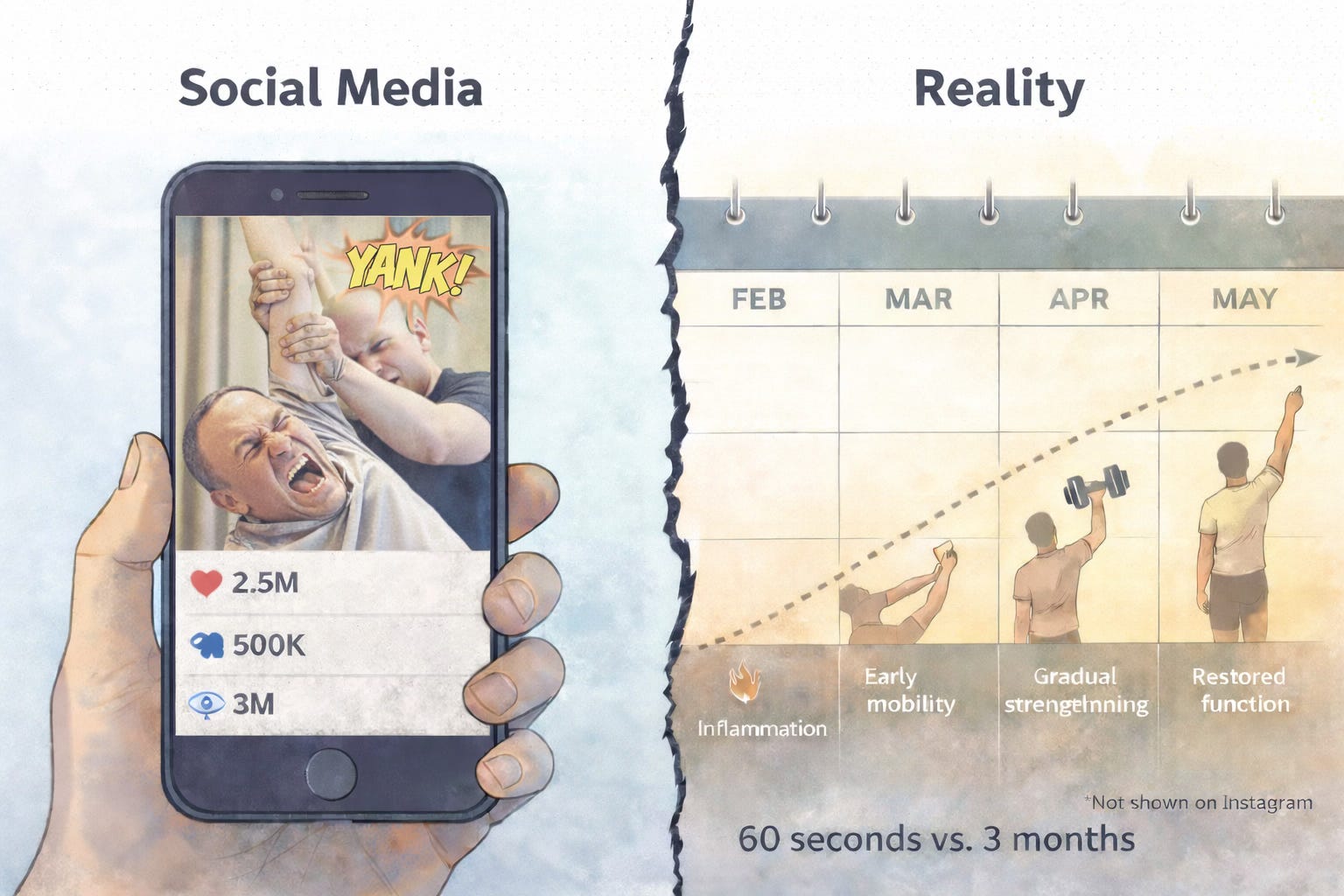
Social media shows the moment, not the trajectory.
When Manipulation Can Help
Hands-on care, including manipulation, can help some people in some situations, particularly when pain is driven mainly by mechanical stiffness and protective guarding.
Clinical guidelines and systematic reviews suggest manipulation can provide short-term pain relief (often days to weeks) for some neck and back pain, with effects similar in magnitude to other recommended treatments when combined with exercise and movement. For example, the American College of Physicians guideline on low back pain lists spinal manipulation as one option among several non-pharmacological approaches.
It tends to be most helpful when:
pain is relatively recent
symptoms are local and mechanical
there are no radicular nerve symptoms (nerve root–related pain that follows a specific pattern down a limb), and no red flags such as progressive neurological deficits, which require medical evaluation
the nervous system is not already highly sensitized
In these cases, short-term relief can create a window where movement feels safer — and that window can be useful if followed by rehabilitation.
Where the Video Narrative Becomes Misleading
Many viral clips implicitly teach this idea:
“If the problem is chronic, it needs stronger force.”
This rarely aligns with pain biology.
Chronic pain often involves heightened sensitivity and threat perception in the nervous system. In these cases, increasing force can sometimes increase guarding and pain, rather than reduce it.
Gentler approaches that build movement tolerance, safety, and confidence are often better tolerated than dramatic mechanical inputs — even if they look less impressive online.
Frozen Shoulder: A Condition Often Misunderstood Online
True frozen shoulder (adhesive capsulitis) involves inflammation and fibrosis (scar-like tissue formation) of the shoulder joint capsule. It typically progresses through stages of pain, stiffness, and eventual resolution.
If left untreated, natural recovery often occurs over 12–24 months, though the course varies widely between individuals. This timeline is commonly reported in orthopedic and rehabilitation reviews, including narrative and systematic reviews in journals such as Shoulder & Elbow and similar peer-reviewed sources.
With targeted treatment — including inflammation control, progressive mobilization, and addressing protective movement patterns — many patients appear to manage pain and maintain better function during the recovery process, based on clinical observation. While the natural timeline varies considerably, structured rehabilitation often helps people remain less pain-reactive and maintain better function as the capsule heals, even if it does not dramatically shorten the biological course itself.
Forceful manipulation remains controversial for this condition.
There is a medical procedure called manipulation under anesthesia (MUA) — where the shoulder is forcibly moved while the patient is sedated. It is sometimes used in refractory cases (cases that have not improved despite appropriate treatment over time), but it carries risks and has mixed evidence.
Outside of that context, vigorous manual manipulation during the inflammatory phase may increase pain and protective guarding, rather than improve long-term outcomes.
For most people, progress tends to come from staged rehabilitation — gentle mobilization, inflammation control, progressive strengthening, and time — even if this looks unimpressive on video.
Who Benefits From “Adjustment Culture” Online
It’s worth noting that dramatic adjustment content performs extremely well on social media.
Algorithms tend to reward content that is:
visual and immediate
emotionally satisfying
simple to interpret (”it was out, now it’s fixed”)
This naturally amplifies certain presentations of care over others — not because of practitioner intent, but because the medium itself favors high-drama narratives.
Over time, this shapes public expectation: treatments that look dramatic feel more legitimate, while slower, progressive care can appear evasive or weak.
Relief vs. Recovery — A Crucial Distinction
A useful way to think about pain treatment:
Relief = symptoms reduce temporarily
Recovery = function improves and the system becomes less reactive over time
Immediate relief is real — but it does not automatically mean the underlying drivers have changed.
That said, sometimes immediate relief does initiate recovery, particularly when pain was maintaining a protective cycle. Breaking that cycle can allow movement and natural healing to resume.
The key question is not how fast relief happens, but whether improvement is maintained and builds over time.
The Real Question to Ask
When something helps briefly but doesn’t last, the question isn’t:
“Should I do it again?”
It’s:
What system is driving my pain right now — acute tissue irritation, nerve sensitivity, protective guarding, or a mix?
And just as important:
Is this treatment addressing that driver, or only creating temporary sensory distraction?
Final Thought
The issue isn’t that hands-on techniques never work.
The issue is assuming that what looks powerful on a screen must be the right answer for every kind of pain — especially chronic pain.
Pain doesn’t need performance.
It needs accuracy.
And accuracy is rarely dramatic.
A Note on What Comes Next (For Readers Who Want More Clarity)
This article is meant to explain why expectations around pain treatment have become distorted, not to tell you exactly what to do next.
In the next piece — available to paid subscribers — I’ll go one level deeper and lay out a structured self-assessment framework that helps you recognize:
which pain driver is likely dominant right now (for instance, learning to distinguish whether your shoulder pain is driven by active inflammation, protective guarding, or nerve sensitivity — and why that distinction changes what treatment makes sense)
when a treatment is well-matched vs mismatched
and when it’s time to stop chasing techniques and reassess the strategy
It’s designed to orient you — not to diagnose — and to reduce the trial-and-error that keeps so many people stuck.
If you’ve ever felt confused by conflicting advice, that’s where the clarity starts.
Disclaimer:
This newsletter is for general educational purposes only. It reflects clinical observations and experience, not individual medical advice. Pain is complex and varies from person to person; please consult a qualified healthcare professional for diagnosis or treatment specific to your situation.